| --- |
| license: bsd-3-clause |
| library_name: braindecode |
| pipeline_tag: feature-extraction |
| tags: |
| - eeg |
| - biosignal |
| - pytorch |
| - neuroscience |
| - braindecode |
| - convolutional |
| --- |
| |
| # FBMSNet |
|
|
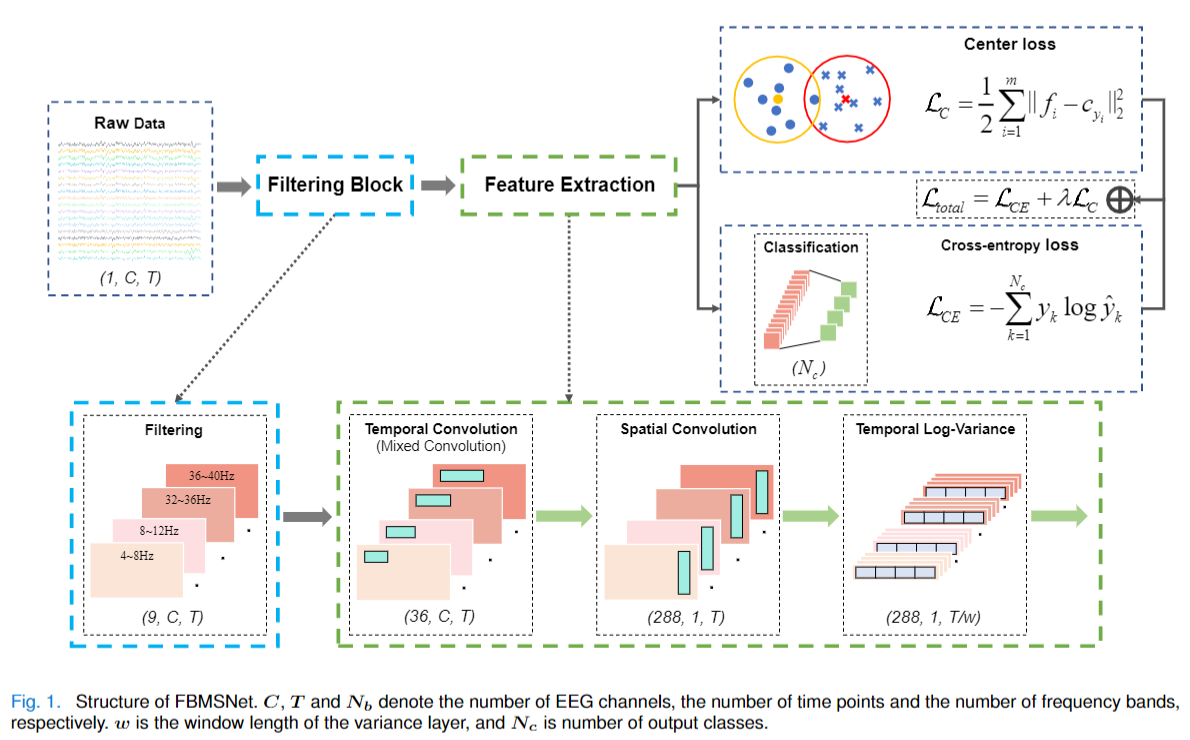
| FBMSNet from Liu et al (2022) [fbmsnet]. |
|
|
| > **Architecture-only repository.** Documents the |
| > `braindecode.models.FBMSNet` class. **No pretrained weights are |
| > distributed here.** Instantiate the model and train it on your own |
| > data. |
|
|
| ## Quick start |
|
|
| ```bash |
| pip install braindecode |
| ``` |
|
|
| ```python |
| from braindecode.models import FBMSNet |
| |
| model = FBMSNet( |
| n_chans=22, |
| sfreq=250, |
| input_window_seconds=4.0, |
| n_outputs=4, |
| ) |
| ``` |
|
|
| The signal-shape arguments above are illustrative defaults — adjust to |
| match your recording. |
|
|
| ## Documentation |
| - Full API reference: <https://braindecode.org/stable/generated/braindecode.models.FBMSNet.html> |
| - Interactive browser (live instantiation, parameter counts): |
| <https://huggingface.co/spaces/braindecode/model-explorer> |
| - Source on GitHub: <https://github.com/braindecode/braindecode/blob/master/braindecode/models/fbmsnet.py#L19> |
|
|
|
|
| ## Architecture |
|
|
|  |
|
|
|
|
| ## Parameters |
|
|
| | Parameter | Type | Description | |
| |---|---|---| |
| | `n_bands` | int, default=9 | Number of input channels (e.g., number of frequency bands). | |
| | `n_filters_spat` | int, default=36 | Number of output channels from the MixedConv2d layer. | |
| | `temporal_layer` | str, default='LogVarLayer' | Temporal aggregation layer to use. | |
| | `n_dim: int, default=3` | — | Dimension of the temporal reduction layer. | |
| | `stride_factor` | int, default=4 | Stride factor for temporal segmentation. | |
| | `dilatability` | int, default=8 | Expansion factor for the spatial convolution block. | |
| | `activation` | nn.Module, default=nn.SiLU | Activation function class to apply. | |
| | `kernels_weights` | Sequence[int], default=(15, 31, 63, 125) | Kernel sizes for the MixedConv2d layer. | |
| | `cnn_max_norm` | float, default=2 | Maximum norm constraint for the convolutional layers. | |
| | `linear_max_norm` | float, default=0.5 | Maximum norm constraint for the linear layers. | |
| | `filter_parameters` | dict, default=None | Dictionary of parameters to use for the FilterBankLayer. If None, a default Chebyshev Type II filter with transition bandwidth of 2 Hz and stop-band ripple of 30 dB will be used. | |
| | `verbose: bool, default False` | — | Verbose parameter to create the filter using mne. | |
|
|
|
|
| ## References |
|
|
| 1. Liu, K., Yang, M., Yu, Z., Wang, G., & Wu, W. (2022). FBMSNet: A filter-bank multi-scale convolutional neural network for EEG-based motor imagery decoding. IEEE Transactions on Biomedical Engineering, 70(2), 436-445. |
| 2. Liu, K., Yang, M., Yu, Z., Wang, G., & Wu, W. (2022). FBMSNet: A filter-bank multi-scale convolutional neural network for EEG-based motor imagery decoding. https://github.com/Want2Vanish/FBMSNet |
|
|
|
|
| ## Citation |
|
|
| Cite the original architecture paper (see *References* above) and braindecode: |
|
|
| ```bibtex |
| @article{aristimunha2025braindecode, |
| title = {Braindecode: a deep learning library for raw electrophysiological data}, |
| author = {Aristimunha, Bruno and others}, |
| journal = {Zenodo}, |
| year = {2025}, |
| doi = {10.5281/zenodo.17699192}, |
| } |
| ``` |
|
|
| ## License |
|
|
| BSD-3-Clause for the model code (matching braindecode). |
| Pretraining-derived weights, if you fine-tune from a checkpoint, |
| inherit the licence of that checkpoint and its training corpus. |
|
|


