| --- |
| license: bsd-3-clause |
| library_name: braindecode |
| pipeline_tag: feature-extraction |
| tags: |
| - eeg |
| - biosignal |
| - pytorch |
| - neuroscience |
| - braindecode |
| - convolutional |
| --- |
| |
| # FBLightConvNet |
|
|
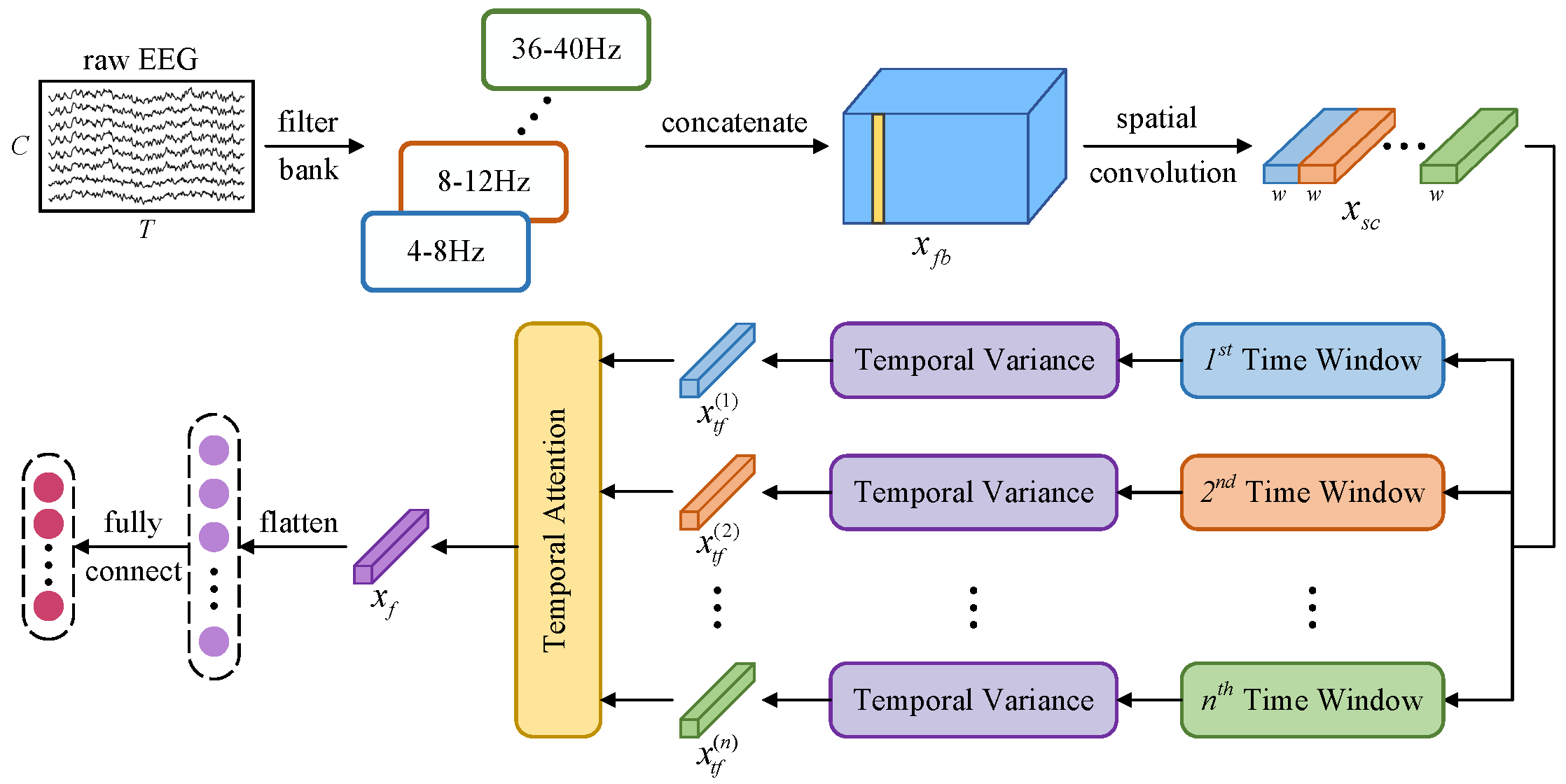
| LightConvNet from Ma, X et al (2023) [lightconvnet]. |
|
|
| > **Architecture-only repository.** Documents the |
| > `braindecode.models.FBLightConvNet` class. **No pretrained weights are |
| > distributed here.** Instantiate the model and train it on your own |
| > data. |
|
|
| ## Quick start |
|
|
| ```bash |
| pip install braindecode |
| ``` |
|
|
| ```python |
| from braindecode.models import FBLightConvNet |
| |
| model = FBLightConvNet( |
| n_chans=22, |
| sfreq=250, |
| input_window_seconds=4.0, |
| n_outputs=4, |
| ) |
| ``` |
|
|
| The signal-shape arguments above are illustrative defaults — adjust to |
| match your recording. |
|
|
| ## Documentation |
| - Full API reference: <https://braindecode.org/stable/generated/braindecode.models.FBLightConvNet.html> |
| - Interactive browser (live instantiation, parameter counts): |
| <https://huggingface.co/spaces/braindecode/model-explorer> |
| - Source on GitHub: <https://github.com/braindecode/braindecode/blob/master/braindecode/models/fblightconvnet.py#L18> |
|
|
|
|
| ## Architecture |
|
|
|  |
|
|
|
|
| ## Parameters |
|
|
| | Parameter | Type | Description | |
| |---|---|---| |
| | `n_bands` | int or None or list of tuple of int, default=8 | Number of frequency bands or a list of frequency band tuples. If a list of tuples is provided, each tuple defines the lower and upper bounds of a frequency band. | |
| | `n_filters_spat` | int, default=32 | Number of spatial filters in the depthwise convolutional layer. | |
| | `n_dim` | int, default=3 | Number of dimensions for the temporal reduction layer. | |
| | `stride_factor` | int, default=4 | Stride factor used for reshaping the temporal dimension. | |
| | `activation` | nn.Module, default=nn.ELU | Activation function class to apply after convolutional layers. | |
| | `verbose` | bool, default=False | If True, enables verbose output during filter creation using mne. | |
| | `filter_parameters` | dict, default={} | Additional parameters for the FilterBankLayer. | |
| | `heads` | int, default=8 | Number of attention heads in the multi-head attention mechanism. | |
| | `weight_softmax` | bool, default=True | If True, applies softmax to the attention weights. | |
| | `bias` | bool, default=False | If True, includes a bias term in the convolutional layers. | |
|
|
|
|
| ## References |
|
|
| 1. Ma, X., Chen, W., Pei, Z., Liu, J., Huang, B., & Chen, J. (2023). A temporal dependency learning CNN with attention mechanism for MI-EEG decoding. IEEE Transactions on Neural Systems and Rehabilitation Engineering. |
| 2. Link to source-code: https://github.com/Ma-Xinzhi/LightConvNet |
|
|
|
|
| ## Citation |
|
|
| Cite the original architecture paper (see *References* above) and braindecode: |
|
|
| ```bibtex |
| @article{aristimunha2025braindecode, |
| title = {Braindecode: a deep learning library for raw electrophysiological data}, |
| author = {Aristimunha, Bruno and others}, |
| journal = {Zenodo}, |
| year = {2025}, |
| doi = {10.5281/zenodo.17699192}, |
| } |
| ``` |
|
|
| ## License |
|
|
| BSD-3-Clause for the model code (matching braindecode). |
| Pretraining-derived weights, if you fine-tune from a checkpoint, |
| inherit the licence of that checkpoint and its training corpus. |
|
|


