

license: apache-2.0
language:
  - en
arxiv: 2607.2158
tags:
  - video-generation
  - image-to-video
  - controllable-generation
  - graph-conditioning
  - computer-vision
GraphVid: Interactive Graph-Controllable Video Generation
Vedant Shah, Onkar Susladkar, Tushar Prakash, Kiet A. Nguyen, Tianjiao Yu, Adheesh Juvekar, Muntasir Wahed, Ismini Lourentzou
🎉 Accepted to ECCV 2026
📄 Paper · 🌐 Project Page · 💻 Code · 🤗 GraphVid-Bench
Overview
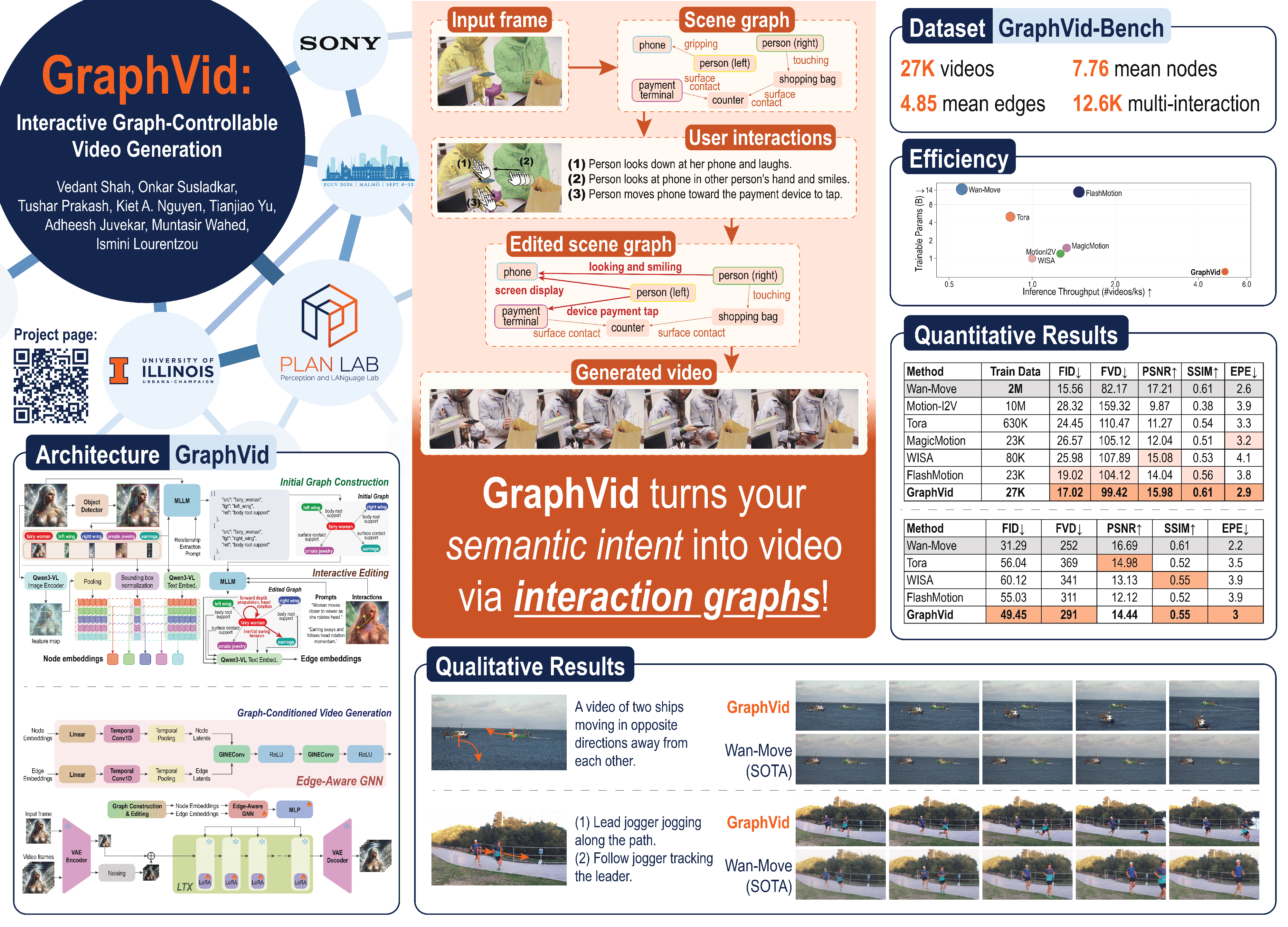
GraphVid is an interactive graph-conditioned framework for controllable image-to-video generation.
Rather than requiring users to specify exact motion trajectories, GraphVid captures semantic interaction intent using structured interaction graphs. Users interact directly with objects in an input image, and these interactions are translated into graph-based conditioning that guides video generation.
GraphVid turns semantic interaction intent into video through structured interaction graphs.
Key Idea
GraphVid represents a scene using an interaction graph, where objects are represented as nodes and relationships or intended interactions are represented through edges.
User interactions are performed directly on the input image rather than on the graph itself. These interactions are interpreted and translated into an updated graph representation that captures the user's intended action.
The resulting graph provides structured conditioning to the video generation model:
the graph specifies what should happen, while the pretrained video backbone determines how the generated video should look and move.
Highlights
Semantic interaction control: Represents intended object interactions explicitly rather than treating control solely as geometric motion.
Interaction graphs: Uses structured graph representations to encode entities, relationships, and intended dynamics.
Image-based user interaction: Users interact directly with objects in the input image; the underlying graph is constructed and updated automatically.
Single- and multi-object control: Supports interactions involving individual objects as well as relationships between multiple objects.
GraphVid-Bench: Provides an interaction-focused video benchmark with structured relational annotations.
Lightweight conditioning: Introduces graph-based control while leveraging a pretrained video generation backbone.
Resources
- Paper: GraphVid: Interactive Graph-Controllable Video Generation
- Project Page: plan-lab.github.io/projects/graphvid
- Code: github.com/PLAN-Lab/GraphVid
- GraphVid-Bench: Download from Hugging Face
- ECCV 2026 Poster: View Poster
Citation
If you find GraphVid useful in your research, please consider citing our work:
@article{shah2026graphvid,
  title={GraphVid: Interactive Graph-Controllable Video Generation},
  author={Shah, Vedant and Susladkar, Onkar and Prakash, Tushar and Nguyen, Kiet A. and Yu, Tianjiao and Juvekar, Adheesh and Wahed, Muntasir and Lourentzou, Ismini},
  journal={arXiv preprint arXiv:2607.21580},
  year={2026}
}