new

Get trending papers in your email inbox!

Subscribe

Trending Papers

byAK and the research community

Trending Papers
Submitted by
Drexubery

WorldCrafter: Consistent Video World Model with Implicit 3D-aware Memory

Video world models enable interactive exploration of dynamic environments, yet struggle to respect prior observations over long horizons and across viewpoints. We present WorldCrafter, a video world model that learns a camera-queryable implicit 3D-aware memory for this purpose. The key insight is to let the requested viewpoint shape how multi-view evidence is compressed into the video generator's limited token budget. Trained jointly with the video generator, a memory encoder and pose-conditioned readout module integrate historical observations into a fixed set of target view-specific tokens before denoising, without explicit depth-based correspondences. By combining this memory with recent temporal context and few-step distillation, WorldCrafter enables streaming scene exploration from a single input image or text prompt. Experiments across static and dynamic scenes show substantial gains in long-horizon consistency and camera-control accuracy while preserving visual quality during minute-scale exploration.

TencentARC ARC Lab, Tencent · Sep 21, 2026

TradingAgents: Multi-Agents LLM Financial Trading Framework

A multi-agent framework using large language models for stock trading simulates real-world trading firms, improving performance metrics like cumulative returns and Sharpe ratio.

  • 4 authors
· Dec 28, 2024
Submitted by
andito

SmolDocling: An ultra-compact vision-language model for end-to-end multi-modal document conversion

SmolDocling is a compact vision-language model that performs end-to-end document conversion with robust performance across various document types using 256M parameters and a new markup format.

ibm-granite IBM Granite · Mar 14, 2025
Submitted by
Michaelqaz

GAE: Learning a Geometry-Native Latent Space for 3D-Consistent World Generation

We present a compact geometry-native latent space as a shared foundation for perception and generation. Visual generators can produce photorealistic frames without preserving a consistent 3D scene. We argue that this is not only a modeling problem but also a representation problem: generators typically evolve appearance-centric latents, while perception models recover geometry in a semantically rich space that encodes cross-view structure. Rather than adding geometry as another output, we reparameterize a geometry foundation model's features into a compact latent space for generation. We realize this shift with the geometry-native autoencoder (GAE), whose latent is jointly decodable to appearance, depth, cameras, and point maps. With this state, a standard conditional flow supports diverse generation tasks. In controlled comparisons that hold the generator and training protocol fixed, replacing the latent with GAE improves both visual quality and independently measured 3D coherence: FVD falls by 12.7% and 23.1% on RealEstate10K and DL3DV, and camera-trajectory error is halved on RealEstate10K. Together, these results show that the latent space is central to geometry-consistent generation and can serve as a shared interface between perception and generation.

TencentARC ARC Lab, Tencent · Sep 21, 2026
Submitted by
taesiri

GameHorizon Suite: Multi-Horizon Data and Evaluation in Gameplay

Modern video games provide a measurable testbed for AI models, combining abilities of visual understanding, instruction decomposition, goal planning, and precise action control over multiple temporal horizons. Existing datasets and benchmarks, however, either cover a narrow range of games, lack language instructions, or rely on high-variance online rollouts. To address these challenges, we introduce GameHorizon, a unified data and evaluation suite that measures gameplay capabilities at different horizons for diverse model families. GameHorizon Suite consists of three components. First, GameHorizon-Annotator is a scalable and automated annotation pipeline for multi-horizon instructions. Second, utilizing the pipeline, we construct GameHorizon-Data, the first large-scale AAA gameplay dataset with temporally aligned videos, player actions, and multi-horizon instructions. It comprises 5,000 hours of recordings from 21 games, collected by 100 human expert players. Third, we build GameHorizon-Bench with reproducible offline and stepwise online testing. The offline track enables reproducible evaluation using thousands of standardized questions organized into three primary tasks and a series of diagnostic variants, while the online track tests whether offline scores reflect actual gameplay capabilities and localizes failures to specific steps within long-horizon gameplay. Based on our GameHorizon Suite, we evaluate 47 models through more than one million model invocations, revealing a meaningful hierarchy of task difficulty and pronounced differences in model capabilities. Our work can provide a standardized yardstick for evaluating gameplay capabilities across horizons and model families. We will release our dataset, annotator, and benchmark to facilitate future research.

tencent Tencent · Sep 21, 2026
Submitted by
a43992899

YuE: Scaling Open Foundation Models for Long-Form Music Generation

YuE, a family of open foundation models based on LLaMA2, can generate long-form music with aligned lyrics, coherent structure, and appropriate accompaniment using innovative techniques in next-token prediction, conditioning, and pre-training.

  • 57 authors
· Mar 11, 2025
Submitted by
akhaliq

OpenDevin: An Open Platform for AI Software Developers as Generalist Agents

OpenDevin is a platform for developing AI agents that interact with the world by writing code, using command lines, and browsing the web, with support for multiple agents and evaluation benchmarks.

  • 24 authors
· Jul 23, 2024
Submitted by
oriuta

Apodex 1.1: Scaling Agentic Intelligence for Complex Work

Apodex 1.1 improves sustained, verifiable progress on complex real-world tasks by scaling executable environments and training agents to coordinate long-horizon work with state maintenance and recovery.

apodex Apodex · Aug 24, 2026
Submitted by
richardxp888

RRSI: Regularized Recursive Self-Improvement of Agent Harnesses

An LLM agent's capability is largely magnified by its harness, namely the prompts, control flow, tooling, memory, and context management surrounding the frozen backbone model. Recent methods increasingly automate this process by iteratively proposing and selecting component-wise edits of an agent harness, practically establishing a form of recursive self-improvement (RSI) at the agent-system level. However, such recursive evolution may overfit by memorizing the training tasks, showing large in-distribution gains that shrink or even vanish on out-of-distribution benchmarks. We introduce Regularized Recursive Self-Improvement of Agent Harnesses (RRSI), which incorporates the principles of regularizations into harness self-improvement by constraining the evolution candidate proposal and selection. The proposer operates with a temporally annealed budget, limiting how many edits a candidate can bundle, and it encourages unexplored trajectories based on evolution history. The selector is equipped with a critic and a pruner: the critic screens benchmark-specific proposals, while the pruner, removes changes that are too small, too expensive, or no longer useful. Together these constraints favor reusable agent mechanisms over benchmark-specific ones or even noises. Across eight benchmarks spanning coding, agentic workspace and engineering design tasks, RRSI gains up to 14.1 points on the split it evolves against and up to 4.7 points on the five out-of-distribution benchmarks, while producing a harness that runs on 30% fewer policy tokens than the unregularized evolution. Code is available at https://github.com/google-research/rrsi and project page is https://regularized-rsi.com/.

google Google · Sep 21, 2026
Submitted by
Sensen02

SoL-Pi: Recursively Scaling Auto-Research Loops for Efficient Agent Harness

As coding agents move from supervised code completion to unattended, around-the-clock exploration, their work expands from isolated predictions into long trajectories of reasoning, tool use, and feedback. Token efficiency therefore becomes important for scaling recursive self-improvement. We take an RSI-inspired approach at the harness layer, scaling auto-research loops across increasingly numerous and diverse environments for harness rollouts. At this scale, the process yields reusable improvements that transfer beyond their development setting, moving automated harness discovery toward production-level outcomes. Four mechanisms survive selection and form SoL-Pi, spanning action execution, context compaction, observation handling, and delegated reading. On the 51-task EdgeBench evaluation, SoL-Pi achieves performance comparable to Pi across GPT-5.6 Sol and Opus 5 while reducing recorded token traffic by 44.7-49.0% and API cost by about one third. In other words, estimated hourly savings are \8.75-13.50 relative to native Codex and Claude Code harnesses, and \4.36-5.71 relative to Pi.

nvidia NVIDIA · Sep 17, 2026
Submitted by
andy-yang

FreeToken: Efficient Edge-Native MoE Serving with Bandwidth-Adaptive Execution

FreeToken is an edge-native Mixture-of-Experts serving system that dynamically maps computation and model state onto heterogeneous local hardware to run large open-weight models on personal machines.

A decoder-only foundation model for time-series forecasting

A large language model adapted for time-series forecasting achieves near-optimal zero-shot performance on diverse datasets across different time scales and granularities.

  • 4 authors
· Oct 14, 2023
Submitted by
akhaliq

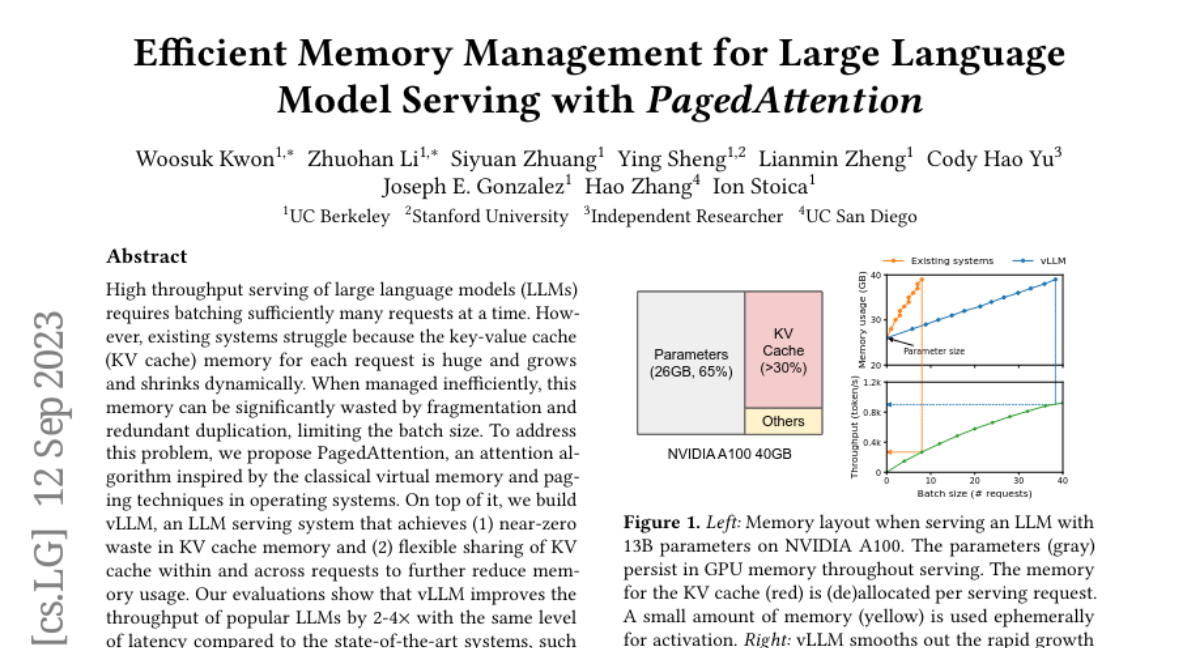
Efficient Memory Management for Large Language Model Serving with PagedAttention

PagedAttention algorithm and vLLM system enhance the throughput of large language models by efficiently managing memory and reducing waste in the key-value cache.

  • 9 authors
· Sep 12, 2023
Submitted by
zwq2018

Spatial-Interactor: Learning Spatial Reasoning through Interaction with the Observable Physical World

Spatial reasoning is essential for vision-language models (VLMs) to understand and act in the physical world. Reasoning in dynamic environments requires VLMs to perceive local state transitions caused by object motion and viewpoint changes and integrate them over long trajectories to maintain an updated spatial state, yet existing VLMs remain limited in both capabilities. Current spatial training primarily focuses on static questions about object attributes and spatial relations, providing limited direct supervision for state transitions; in contrast, interaction trajectories naturally connect a preceding observation, an action, and a subsequent observation, offering direct supervision for local state transitions, while complete trajectories reveal dependencies among consecutive transitions. We therefore introduce Spatial-Interactor, a framework that trains VLMs to model physical-world state transitions through interaction, organizing this learning process into a three-level curriculum covering L1 passive world-state transitions, L2 active self-state transitions, and L3 long-horizon interaction trajectories. Accordingly, we construct the Learning from Spatial Interaction dataset (LSI-108K) from simulated and real interaction trajectories, with tasks aligned with the objective of each level. Our two-stage training strategy applies Supervised Fine-Tuning (SFT) to L1 and L2 for local transition modeling, and On-Policy Distillation (OPD) then uses privileged self-distillation: a teacher branch given segment-level transition descriptions supervises the student's on-policy CoT, helping the student learn to integrate consecutive transitions over L3 long trajectories. Experiments across multiple VLMs and spatial benchmarks show consistent gains in local transition modeling and long-horizon integration.

OmniAI-ZJU ZJU-OmniAI · Sep 19, 2026
Submitted by
taesiri

Paper2Agent: Reimagining Research Papers As Interactive and Reliable AI Agents

Paper2Agent converts research papers into interactive AI agents to facilitate knowledge dissemination and enable complex scientific queries through natural language.

  • 4 authors
· Sep 8, 2025
Submitted by
taesiri

MinerU2.5: A Decoupled Vision-Language Model for Efficient High-Resolution Document Parsing

MinerU2.5, a 1.2B-parameter document parsing vision-language model, achieves state-of-the-art recognition accuracy with computational efficiency through a coarse-to-fine parsing strategy.

  • 61 authors
· Sep 26, 2025
Submitted by
taesiri

Unlimited OCR Works

Unlimited OCR introduces Reference Sliding Window Attention to eliminate growing memory consumption during long-sequence OCR tasks, enabling efficient transcription of multiple pages in a single forward pass.

baidu BAIDU · Jun 22, 2026
Submitted by
zhifeixie

VoiceMem: Streaming Dual-Brain Memory for Real-Time Interaction

VoiceMem introduces a dual-brain streaming memory architecture for speech language models that improves retrieval accuracy, emotional personalization, and real-time efficiency.

Submitted by
ChengCui

PaddleOCR-VL-1.6: Expanding the Frontier of Document Parsing with Under-Optimized Region Refinement and Progressive Post-Training

PaddleOCR-VL-1.6 enhances document parsing performance through targeted data optimization and progressive post-training techniques, achieving state-of-the-art results on OmniDocBench v1.6.

PaddlePaddle PaddlePaddle · Jun 2, 2026

Harness VLA: Steering Frozen VLAs into Reliable Manipulation Primitives via Memory-Guided Agents

Language-conditioned manipulation requires both precise contact-rich control and robust reasoning over language, scenes, and long horizons. End-to-end Vision-Language-Action (VLA) models provide strong local visuomotor skills, but they are trained on in-distribution task trajectories and often fail under deployment perturbations such as semantic retargeting, goal re-binding, spatial-layout shifts, and unstable local contacts. LLM coding agents provide complementary semantic and compositional reasoning, but purely analytic primitives struggle with irregular grasping, constrained placement, and articulated-object interaction. We present Harness VLA, a memory-augmented agentic framework that exposes a frozen VLA as a retryable contact-rich primitive and composes it with a small fixed library of analytic primitives for grounding, staging, transport, navigation, and release. Rather than expanding the skill library, the harness learns the operating range of these fixed primitives from task-specific execution traces, global success rules, and failure models. By lifting semantic re-grounding, non-contact execution, and VLA re-staging to the planner while reserving the frozen VLA for local contact-rich phases, Harness VLA extends pretrained VLAs beyond their original trajectory distribution without finetuning. Across perturbed tabletop, household kitchen, and clean-to-randomized bimanual manipulation, Harness VLA improves over the strongest relevant baselines by 38.6 and 25.4 percentage points on LIBERO-Pro and RoboCasa365, respectively, and reaches 58.4% on RoboTwin C2R.

  • 16 authors
· Jul 9, 2026
Submitted by
JarvisPei

NeoHorse-1: Towards Recursive Self-Improvement via Agentic Post-Training with Routing Harness

NeoHorse-1 uses agentic post-training with intelligent routing, structured feedback loops, and curriculum-based distillation to improve model capabilities across agent benchmarks.

TokenRhythm TokenRhythm · Sep 8, 2026
Submitted by
TongZheng1999

Dream-RSI: Recursive Self-Improvement through Evolving Worlds

Dream-RSI enables scalable recursive self-improvement by using historical discovery replay to evaluate exploration policies offline, reducing costly online evaluations.

google Google · Sep 14, 2026
Submitted by
talor-abr

SPEED-Bench: A Unified and Diverse Benchmark for Speculative Decoding

Speculative Decoding evaluation requires diverse workloads to accurately measure performance, which existing benchmarks lack, prompting the introduction of SPEED-Bench for standardized assessment across semantic domains and serving regimes.

nvidia NVIDIA · Feb 10, 2026
Submitted by
taesiri

AgentScope 1.0: A Developer-Centric Framework for Building Agentic Applications

AgentScope enhances agentic applications by providing flexible tool-based interactions, unified interfaces, and advanced infrastructure based on the ReAct paradigm, supporting efficient and safe development and deployment.

  • 23 authors
· Aug 22, 2025
Submitted by
akhaliq

Very Large-Scale Multi-Agent Simulation in AgentScope

Enhancements to the AgentScope platform improve scalability, efficiency, and ease of use for large-scale multi-agent simulations through distributed mechanisms, flexible environments, and user-friendly tools.

  • 8 authors
· Jul 25, 2024
Submitted by
akhaliq

Mem0: Building Production-Ready AI Agents with Scalable Long-Term Memory

Mem0, a memory-centric architecture with graph-based memory, enhances long-term conversational coherence in LLMs by efficiently extracting, consolidating, and retrieving information, outperforming existing memory systems in terms of accuracy and computational efficiency.

  • 5 authors
· Apr 28, 2025
Submitted by
nielsr

RelateAnything: Real-Time Open-Vocabulary Relation Prediction From Any Inputs

RelateAnything is a lightweight open-vocabulary relation prediction model that accepts arbitrary predicate vocabularies and region sources at inference, trained on a large geometrically verified dataset with positive-unlabeled supervision and evaluated on a new cross-dataset benchmark.

  • 1 authors
· Sep 11, 2026

HuggingFace's Transformers: State-of-the-art Natural Language Processing

Transformers library provides state-of-the-art Transformer architectures and pretrained models for natural language processing tasks with a unified API and emphasis on extensibility and robust deployment.

huggingface Hugging Face · Oct 9, 2019
Submitted by
zhangshaolei

EvoOntology: A Self-Evolving Ontology Layer for Data Agents

Data agents aim to fulfill natural-language instructions over heterogeneous data, including tables, files, and databases. However, data agents face a challenging agent-data gap: heterogeneous data resides outside the agent, while the agent can access it (e.g., column names and file paths) only through generic tools. Existing approaches either let agents directly explore raw data sources or inject manually constructed semantic layers into prompts. However, neither scales well to large heterogeneous data sources nor adapts to different agent behaviors. In this paper, we introduce EvoOntology, a self-evolving ontology layer for data agents. EvoOntology encapsulates the ontology as an MCP server comprising a schema layer, a content layer, and a tool layer, enabling agents to actively query and interact with the ontology at runtime. To this end, we introduce a builder agent for autonomous ontology construction and a self-evolution loop that continuously refines the ontology through attribution-guided typed edits that are accepted only after a backbone-conditional paired evaluation. Experiments on three well-adopted data-agent benchmarks with four LLM backbones demonstrate that EvoOntology consistently outperforms strong baselines and existing semantic-layer approaches, effectively bridging the agent-data gap and enabling more effective interaction with heterogeneous data. Code: https://github.com/ruc-datalab/EvoOntology

RUC-DataLab RUC-DataLab · Sep 14, 2026
Submitted by
milkkarten

Prime Agent: A Self-Improving RLM Harness

Prime Agent is an open-source harness that uses recursive subagents, persistent computation, and agent-to-agent coordination to extend language models' long-horizon capabilities across coding and reasoning tasks.

PrimeIntellect Prime Intellect · Aug 24, 2026

AutoDev: Automated AI-Driven Development

AutoDev is an AI-driven software development framework that automates complex engineering tasks within a secure Docker environment, achieving high performance in code and test generation.

  • 5 authors
· Mar 13, 2024
Submitted by
RuofengYang

ARIS: Autonomous Research via Adversarial Multi-Agent Collaboration

ARIS is an open-source research harness that uses cross-model adversarial collaboration to ensure reliable long-term research outcomes through coordinated execution, orchestration, and assurance layers.

Submitted by
Williams07

One to More, More to One: Category-Aware Iterative Expert Training for Software Engineering Agents

Repository-level software engineering (SWE) comprises heterogeneous task categories, whose progress under pooled agentic reinforcement learning can be uneven: gains in some categories coincide with regressions in others, while aggregate resolution obscures these changes. Motivated by this category see-saw, we develop a category-aware expert-training and policy-integration framework. Executable task construction and SWE Labeler, an evidence-grounded multi-axis labeling system, organize the training pools. Initial category-specific RL improves average training success while leaving uneven instance-level progress, motivating explicit consolidation of successful behavior and policy-adaptive task selection. Same-origin category experts alternate long-horizon Agentic-miniRL with Refresh-Repair-Expand (RRE): the updated policy refreshes instance mastery, reuses its own verified successful trajectories for Repair SFT, and reselects tasks for further RL. Label-routed multi-teacher on-policy distillation (MOPD) consolidates the experts into one deployable student, with ReLU-gated reward extrapolation keeping only each teacher's improving direction over the reference. Expert training and policy integration require no external model to provide solution trajectories or action targets. We evaluate Pooled RL and Balanced RL, expert development, and single-model integration through aggregate and per-category resolution, the minimum category lift over each joint-RL baseline, and expert-gain recovery. The final MOPD policy achieves mean resolution of 58.04% on Pro-618 and 59.00% on SWE-bench Multilingual, improving over the base model by 5.39 and 2.78 percentage points, respectively.

alibabagroup alibaba · Sep 20, 2026

Kronos: A Foundation Model for the Language of Financial Markets

Kronos, a specialized pre-training framework for financial K-line data, outperforms existing models in forecasting and synthetic data generation through a unique tokenizer and autoregressive pre-training on a large dataset.

  • 7 authors
· Aug 2, 2025
Submitted by
taesiri

SkillOpt: Executive Strategy for Self-Evolving Agent Skills

SkillOpt introduces a systematic text-space optimizer for agent skills that trains skills as external agent state with stable updates and zero deployment inference overhead, achieving superior performance across multiple benchmarks and execution environments.

MicrosoftResearch Microsoft Research · May 22, 2026
Submitted by
Lingaaaaaaa

ScienceBuddy: Recursive-in-Recursive Self-Improvement for Interactive Scientific Agents

We introduce and release ScienceBuddy, an interactive scientific research workspace that brings continually improving scientific agents into researchers' everyday workflows. ScienceBuddy supports researchers in carrying out scientific tasks while transforming their requests, feedback, and execution evidence into tasks and evaluation rubrics for continual learning. At its core is recursive-in-recursive self-improvement, a paradigm that couples harness evolution with model reinforcement learning: the inner recursion improves the harness with the model fixed, while the outer recursion trains the model under the improved harness. Harness evolution shapes training experience, and model learning creates new opportunities for harness adaptation. We present case studies of researcher interaction, harness refinement, and model learning, with the benchmark cases spanning four scientific task families. By releasing ScienceBuddy as a research product, we make this paradigm available to the scientific community and take a step toward discovery intelligence: scientific AI that advances through sustained collaboration with researchers and evolves alongside the research it supports. Website: http://science-buddy.io

PhAILabs PhAI Labs · Sep 15, 2026
Submitted by
zeyush

EmbodiedSWE: Coding Agents for Long Horizon Dexterous Robotics

We study coding agents for long-horizon, dexterous robotics and ask whether their solutions can provide scalable supervision for learning general robot policies. To test this, we develop EMBODIEDSWE-BENCH, a simulation benchmark for coding agents spanning contact-rich manipulation, deformable objects, and long-horizon tasks requiring up to half an hour of continuous interaction. We find that frontier coding agents can solve complex long-horizon tasks and transfer prior solutions across both tasks and embodiments. We also design supporting tools that help agents more effectively solve these tasks. However, the resulting solutions require substantial iterative interaction and are typically specialized to individual task instances. We therefore introduce EMBODIEDSWE-GEN, which expands a single solution from coding agent into large diverse trajectories for training a VLA. VLA performance improves with more generated demonstrations, and agent-aided diversification improves generalization to held-out task variations. We also show that a VLA finetuned solely on coding-agent-generated simulation demonstrations completes a long-horizon task on real robot. Together, our framework uses coding agents to solve complex robotics tasks and turn verified solutions into scalable supervision for robot policies.

  • 19 authors
· Sep 23, 2026
Submitted by
Longin-Yu

WeVisDoc: From Coverage to Capability for Robust End-to-End Document Parsing

Document parsing converts document images into structured content and requires reliable performance across diverse layouts and acquisition conditions. Yet training corpora are biased toward common document types and clean digital pages, while expanding coverage alone does not specify how to address a parser's remaining weaknesses. We present WeVisDoc, a two-stage data-centric framework for robust end-to-end document parsing. Stage I broadens semantic, structural, and appearance coverage through heterogeneous data and structure-preserving degradation synthesis. Stage II uses a held-out probe to measure the Stage I parser's residual errors within fixed visual-structural clusters. These diagnostics guide targeted data construction and reallocation of the target-token budget. WeVisDoc-4B achieves an Overall score of 95.38 on OmniDocBench v1.6 and a mean Overall score of 75.54 across the three PureDocBench tracks, ranking first among the compared end-to-end parsers in all four settings. Compared with Stage I, Stage II improves Overall scores for the 2B and 4B models on both benchmarks, with larger gains on the degraded PureDocBench tracks, including a 4.03-point gain for the 4B model on the Real Degraded track.

tencent Tencent · Sep 17, 2026
Submitted by
Harold328

The Past Frames the Future: Memory for Autoregressive Video Generation

Advances in generative models have improved video fidelity, enabling long-horizon generation, interactive world modeling, and evolving visual environments. Autoregressive (AR) video generation extends visual sequences through causal rollouts. However, a fundamental bottleneck emerges: as the generated sequence expands, practical models must operate under strictly bounded context windows, storage, and computational limits. Consequently, critical historical information, e.g., entity identities, dynamic states, and intervention-induced causal changes, often leaves the active context long before its relevance diminishes. Overcoming this limitation and maintaining temporal persistence constitutes a fundamental memory problem. We present a systematic and comprehensive review of memory mechanisms in AR video generation. We formulate memory operationally as persistent historical information maintained across outer AR steps, capable of influencing future generation even after the originating evidence is no longer locally accessible. Building upon this unified framework, we organize the literature through five complementary perspectives: (I) Forms, the representational carriers of history; (II) Functions, the specific semantic and physical information requiring preservation; (III) Operations, the lifecycle of writing, reading, updating, managing, and integrating memory; (IV) Learning, the optimization of memory behaviors under closed-loop rollouts; and (V) Evaluation, the paradigms for diagnosing genuine memory capabilities. We conclude by synthesizing open challenges, including composable and resource-aware memory architectures, trustworthy state updating, self-rollout learning, and standardized evaluation. By bridging representations, mechanisms, and learning paradigms, this paper establishes a structured foundation for developing reliable, memory-conditioned video generation systems.

  • 25 authors
· Sep 23, 2026
Submitted by
nielsr

Ultralytics YOLO26: Unified Real-Time End-to-End Vision Models

YOLO26 addresses real-time vision challenges through a unified model family with NMS-free inference, improved training strategies, and multi-task capabilities spanning detection, segmentation, and pose estimation.

Ultralytics Ultralytics · Jun 2, 2026

PyTorch Distributed: Experiences on Accelerating Data Parallel Training

The PyTorch distributed data parallel module optimizes large-scale model training using techniques like gradient bucketing, computation-communication overlap, and selective synchronization to achieve near-linear scalability.

  • 11 authors
· Jun 28, 2020
Submitted by
dj220001

Jev-Mem: System-One-Controlled Agentic Memory for Efficient AI Agents

Agentic memory is becoming essential for long-horizon AI agents, yet many existing systems rely on autoregressive LLMs to control how memories are organized, retrieved, and used, placing expensive generation on the critical path of memory operations. We introduce \method, a new agentic memory architecture inspired by System-One/System-Two cognition. System One captures fast, lightweight decision-making, whereas System Two performs slower, deliberative reasoning. Jev-Mem brings this division of labor to agentic memory through a dedicated System-One control plane, a structured multi-relational memory plane, and a System-Two reasoning plane. The System-One controller governs memory typing and relational organization during construction, and dynamically performs query routing, retrieval-budget allocation, graph traversal, candidate scoring, and adaptive stopping during retrieval. System Two is invoked only for complex reasoning and answer synthesis. This design improves both memory effectiveness and system efficiency: on LoCoMo Jev-Mem achieves an overall LLM-as-a-Judge score of 0.777, an 11.0\% relative improvement over the strongest baseline, while reducing memory construction time to 158\,s, a 6.6times speedup over the fastest competing memory system, and lowering average query latency to 0.93\,s, a 36.7\% reduction.

  • 3 authors
· Sep 21, 2026
Submitted by
chenwang

HARMONY: Hierarchical Agentic Reasoning for MONocular Image-to-Scene Synthesis

Compositional 3D scene reconstruction has recently been explored from two directions: agentic reasoning that provides semantic understanding of spatial relationships but lacks precise alignment with input images; and visual geometry foundation models that predict dense point maps from input images but the reconstruction quality is limited. Therefore, recovering a complete 3D scene from a single monocular image with accurate inter-object relationships and high-fidelity reconstruction quality remains challenging. In this paper, we present HARMONY, a hierarchical chain-of-thought framework that leverages both agentic reasoning and visual geometry foundation. Given an image of an indoor scene, starting from an empty 3D floorplan, HARMONY first calibrates the camera against the reference image to establish a semantically-grounded spatial frame, then uses agentic VLM reasoning to recover the 3D room layout and an initial placement order. It then places the objects in a hierarchical order, from wall-mounted elements, free-standing furniture, to dependent decorations on top of furniture. We also use depth-first traversal for furniture so each placement conditions on previously resolved structure and a reflective feedback loop to avoid error accumulation. After each object placement by VLM, we use the point cloud estimations to perform geometry-based refinement so that the rendered image aligns better with the input. HARMONY can produce 3D scenes that are semantically consistent and perceptually aligned with the reference image, extending single-image compositional reconstruction to complex indoor scene images. Experiments on synthetic and real-world images demonstrate that HARMONY outperforms the evaluated reconstruction baselines, while qualitative comparisons with GPT-6 Astra suggest more faithful object arrangements and better preservation of scene details.

Submitted by
taesiri

RecreationWorld: Scalable and Verifiable Environments for Hybrid Computer-Use Agents

Computer-use agents (CUAs) have advanced along two separate lines: graphical interaction and software development through code and the command line. Real digital work requires both, interleaved rather than stacked end to end. We study hybrid CUAs that autonomously decide when to explore an interface, implement software, and run and visually verify their artifacts. We introduce RecreationWorld, a five-platform framework built around recreation: given a running reference, an agent must discover its behavior and build a faithful implementation with no prescribed workflow. RecreationWorld provides reproducible environments on Ubuntu, macOS, Windows, Android, and Web, plus a unified harness with native GUI control and coding tools. The running reference serves as an oracle for hidden behavioral tests, providing execution-grounded rewards. We scale trajectory generation with high-quality open-source applications. Models trained on these trajectories improve across five out-of-distribution coding and hybrid computer-use benchmarks and more frequently verify their rendered outputs, providing evidence of transfer beyond recreation. For held-out evaluation, we introduce RecreationBench, comprising 250 diverse tasks across domains and platforms. Reference-grounded programmatic and visual assertions cover action-conditioned outcomes at multiple interaction depths; each is validated on the reference and by human reviewers before the suite is frozen for automatic scoring. GPT-6 Astra leads at 58.1% overall, but passes all programmatic tests on just 2.8% of tasks. Agents reproduce static interface structure more reliably than interactions and computed outputs, while generated applications remain smaller and more monolithic than their references. We release the benchmark, environments, and test suites.

Qwen Qwen · Sep 18, 2026
Submitted by
Yang-Tian

Mira-Scene: Pixel-Aligned Layouts for Generative 3D Scene

Single-image 3D object generation can now produce high-fidelity assets, yet accurately placing them into a coherent scene layout remains an open challenge. A central difficulty lies in how object layout is represented. Holistic methods absorb placement into a scene-level generation process, sacrificing object-level detail. Compositional methods preserve object fidelity by decoupling geometry from layout, but typically parameterize layout as sparse, unbounded pose variables that are difficult to learn and generalize poorly under scarce scene-level supervision.We present Mira-Scene, a compositional 3D scene reconstruction framework that replaces sparse pose regression with dense, bounded correspondence recovery. At its core is the Canonical Coordinate Map (CCM), a pixel-aligned field that maps each visible object pixel to a surface coordinate in the object's bounded canonical space. When paired with a scene-space Point Cloud Map (PCM) from monocular geometry estimation, CCM induces dense canonical-to-scene correspondences from which object transformations are recovered through robust geometric alignment. Because CCM operates in bounded canonical space, it provides a stable prediction target that can be trained from scalable object-level 3D data without requiring scene-level layout annotations. Mira-Scene further introduces a multimodal diffusion transformer that jointly generates object geometry and CCMs, using modality-specific expert streams with shared attention and positional encoding to promote geometry-layout consistency. Experiments on indoor, outdoor, synthetic, and in-the-wild scenes show that Mira-Scene substantially outperforms strong baselines in layout accuracy, achieving relative gains of 39.8% in 3D-IoU and 16.5% in 2D-IoU over SAM3D, using limited open-source training data.

TheHKU Hong Kong University · Sep 20, 2026
Submitted by
yshenaw

ZGCM-1: A Fully Open and Extremely Efficient Foundation Model for Math and Agentic Search

ZGCM-1 is a 7B open foundation model that combines internal reasoning with external tool use, trained via efficient architecture-system co-design, progressive long-context scaling, and autonomous agent workflows to achieve strong reasoning and efficiency.

zgcagi ZGCAGI · Sep 11, 2026

Zep: A Temporal Knowledge Graph Architecture for Agent Memory

Zep, a memory layer service, outperforms MemGPT in the DMR benchmark and LongMemEval by excelling in dynamic knowledge integration and temporal reasoning, critical for enterprise use cases.

  • 5 authors
· Jan 20, 2025
Submitted by
xcjthu

MiniCPM4: Ultra-Efficient LLMs on End Devices

MiniCPM4, a highly efficient large language model for end-side devices, achieves superior performance using innovations in sparse attention, pre-training datasets, training algorithms, and inference systems.

openbmb OpenBMB · Jun 9, 2025
Submitted by
KYLN24

Atria Dawn: The Dawn of Agentic Superintelligence

Atria Dawn Preview is a foundation agentic language model trained through verified tool interactions that achieves strong benchmark results and demonstrates a shift toward human-AI project-level collaboration in scientific research.

internlm Intern Large Models · Sep 14, 2026
Submitted by
BoJack

AuK Technical Report: An Open-Source Foundational Model for Speech Generation and Editing

AuK is an open-source foundational model that unifies speech generation and editing via natural-language instructions and audio context, using a multimodal language model, joint VAE, hybrid rectified-flow Transformer, and efficient distillation for fast inference.

Tencent-Hunyuan Tencent Hunyuan · Sep 8, 2026